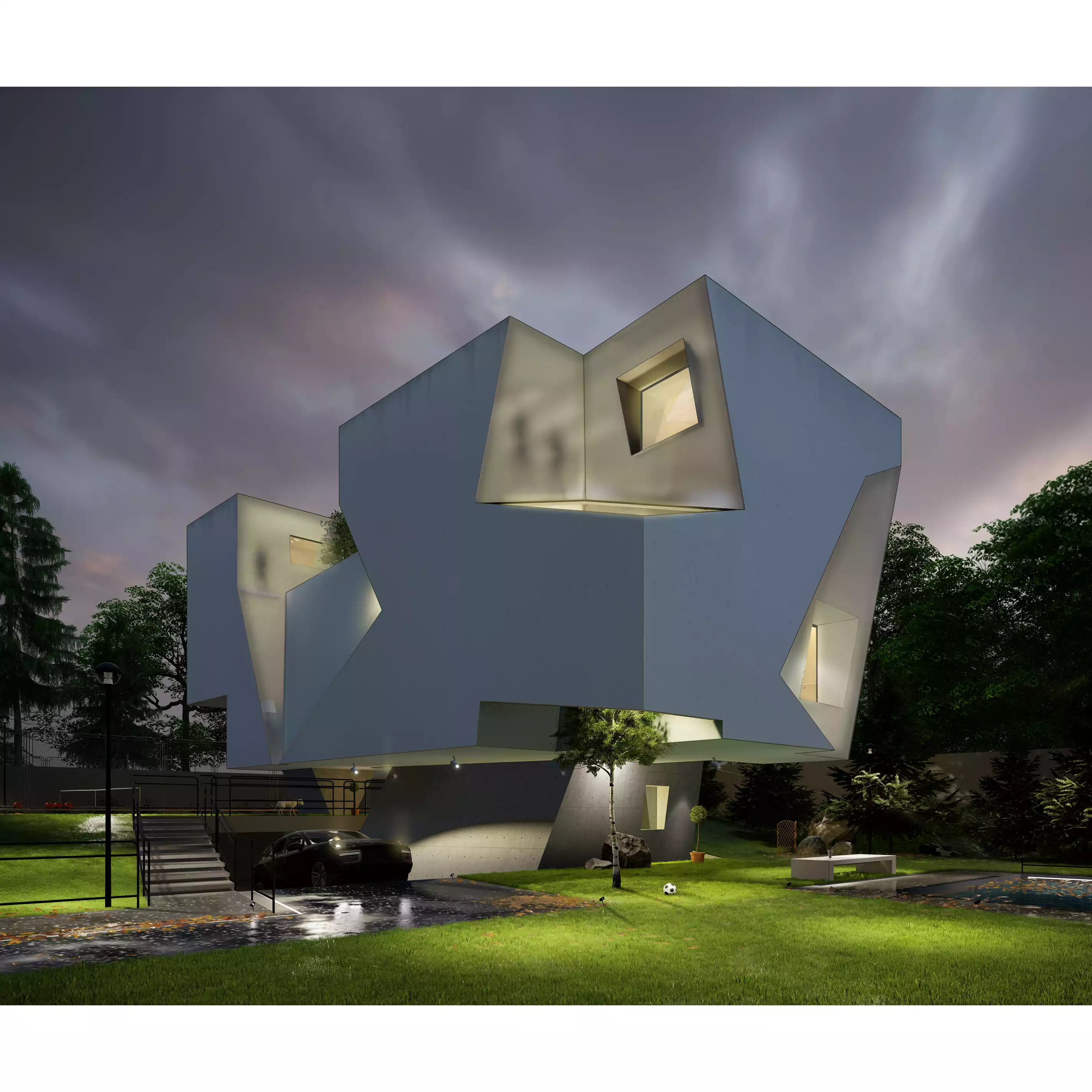
Jajrood VillaGallery
Jajrood
Tehran
The Jajrood Villa–Gallery was conceived at the southern edge of a porcelain production complex, where the primary need was to create a showroom space alongside a temporary residence for guests, buyers, and collaborators. The central concept draws inspiration from the “system of objects” and Jean Baudrillard’s critical perspective on the world of objects—where objects are not merely commodities, but carriers of meaning, representation, and arrangement. In this context, the building is not simply a container of functions, but becomes an object of display itself—an “arranged object” in which movement, viewing, pause, and interaction with products are carefully orchestrated
Formal Concept and Spatial Organization
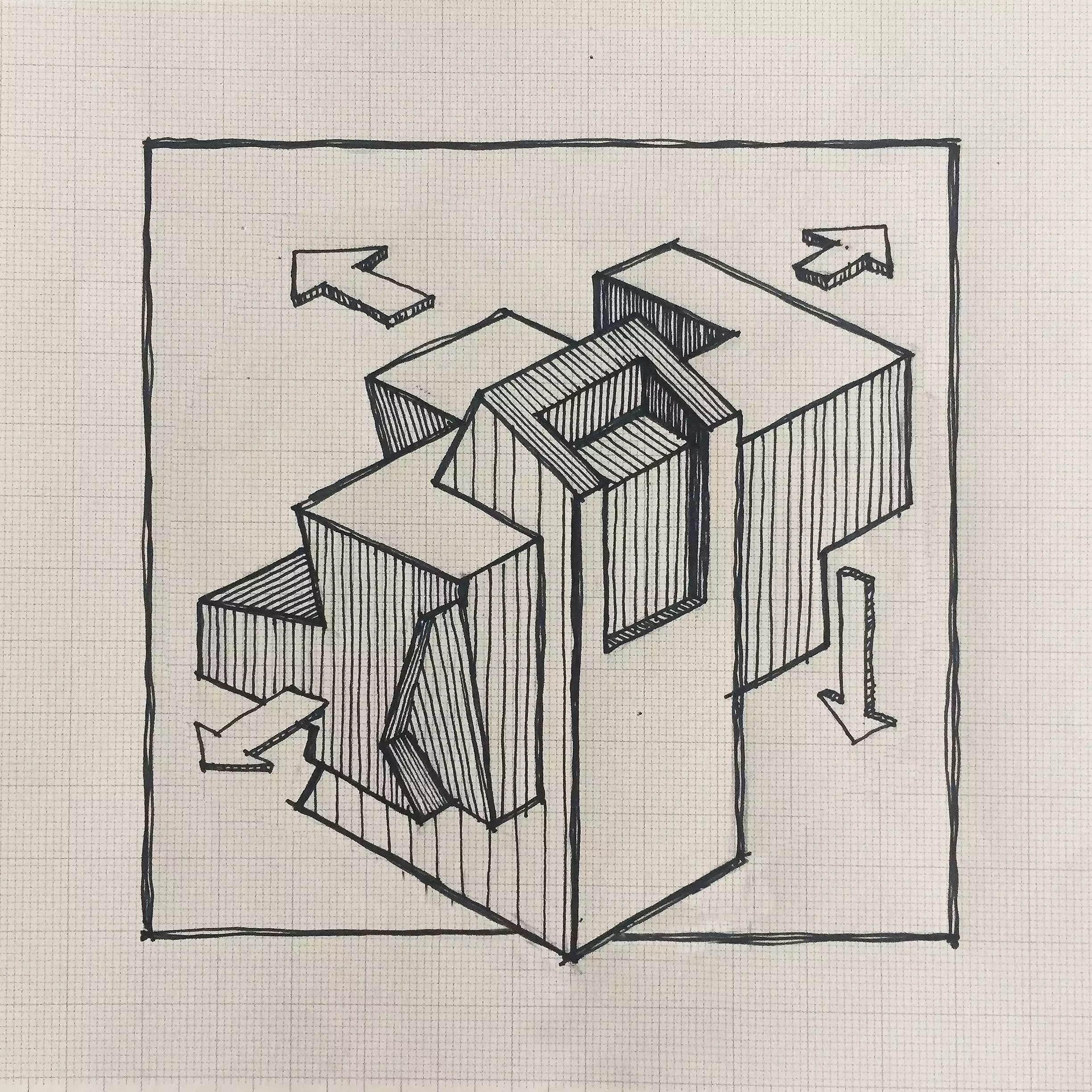
The core of the design is inspired by the form of a ceramic kiln—a central vertical element that functions both structurally and conceptually:
The Central Kiln as the Axis of Meaning:
This core acts as both a structural spine and the conceptual heart of the project, organizing circulation, exhibition, and residential spaces around it.
Circular Spatial Organization:
Rather than dispersing functions, spaces are arranged in a continuous sequence around the central core, creating a gradual and narrative spatial experience—from initial engagement with the products to more private residential areas.
Central Courtyard as a Void:
At the upper level, a central courtyard is introduced as a void carved into the mass. This space enhances natural light and ventilation while providing moments of pause, transforming the experience from purely commercial to spatially contemplative—reinforcing the gallery atmosphere.
Massing and Architectural Language
The project is defined by the concept of a suspended volume—a floating box that is carefully elevated above the ground to create two distinct spatial layers:
Public Layer Below:
The lower level accommodates the showroom and exhibition spaces, offering greater accessibility, openness, and urban presence.
Private Layer Above:
The upper level contains the guesthouse and more intimate residential spaces, creating a quieter and more protected environment.
Subtractive operations—removing portions of the mass—are used as a key design strategy. These carved voids allow light, views, and movement to penetrate the building, preventing it from becoming a sealed object. These subtractions are conceptually inspired by fractures and chips in ceramic objects, reinterpreted architecturally as expressive openings that give the building a distinct identity
Light, Openings, and Movement Experience
The concept of “ceramic fractures” informs the design of openings:
-
Openings function not merely as windows, but as narrative spatial devices
-
Controlled light enters selectively, framing specific views and enhancing spatial focus
-
The interior experience resembles that of a gallery, where light, movement, and spatial sequencing guide visitors progressively
This approach ensures that architecture supports the display of objects while creating a rich spatial journey.
Material Strategy and Tectonic Expression
Reflecting the nature of porcelain and ceramic production, the material language emphasizes the contrast between delicacy and solidity:
-
Smooth, light-colored surfaces referencing the softness and purity of porcelain
-
Darker or metallic elements emphasizing structural clarity and the floating character of the volume
-
Minimal material expression to ensure that the displayed objects remain visually dominant, while architecture serves as a refined spatial frame
Conclusion
The Jajrood Villa–Gallery is a hybrid architectural project that transforms the showroom from a purely commercial space into an architectural and spatial experience. By defining a central kiln as both structural and conceptual core, organizing functions around it, elevating the main volume, and introducing openings inspired by ceramic fractures, the project becomes a distinct architectural object—one that embodies the identity of the products while enhancing the qualities of dwelling, pause, and contemplation through its spatial organization and central courtyard